
Webinar Recap: Who Decides? Power, Gender, and the Women Leading Planetary Health
As we approach our 20th anniversary, Health In Harmony is reflecting on two decades of learning.
Working beside rainforest communities globally, we know that planetary health is shaped by power: who controls resources, whose knowledge is recognized, and who is enabled to make decisions.
In particular, women play an outsized role as stewards of the world’s most climate-critical rainforests, at the forefront of climate solutions and forest protection, and yet often bear the brunt of the costs and challenges caused by climate change, and are under-recognized and under-resourced.
That’s why, on June 10th, Health In Harmony convened a webinar led by sector leaders and change-making community members on the topic of gender equity in climate action: Who Decides? Power, Gender, and the Women Leading Planetary Health.
The goal? To spotlight the woman-led climate solutions that are already creating impact, and discuss how we can collectively better recognize and resource women doing this work.
For those who missed the webinar, watch the recording here:
The gendering of climate action
Gender is a social and cultural construct: the roles, norms, and expectations that society assigns to people are based on the assigned biological sex at birth. Gender does not exist in a vacuum; it's always entangled with other factors like ethnicity, Indigeneity, class, and geography.
As Belai Djandam, Advocacy Manager at Health In Harmony, who hosted the webinar, explained in her opening notes: “Talking about gender and its intersections means acknowledging who is doing the work and who is paying the price. Who decides how forests are managed, who decides what counts as knowledge, who gets heard, and who gets to lead?”
Reinforcing Belai’s comments, Brasilia Florensia Netty, Village Leader, West Kalimantan, Indonesia, joined the conversation to share her personal experience:
“When I decided to run as chief of the village, I had to have extra energy to prove that I deserve to lead the village. I worked harder to overcome and dispel doubts. I had to have a stronger focus compared to men in order to prove women can be leaders when given time and space. Those are the initial challenges, before the work begins.”
Community-led initiatives for gender justice in planetary health
Health In Harmony works beside rainforest communities on countless projects to support gender justice in climate action across climate-critical rainforest basins globally. At Who Decides?, contributors shared a handful of examples and first-hand experiences of the impact these solutions are having.
In Indonesia, with support from Health In Harmony’s Indonesian partner ASRI, Brasilia Florensia Netty describes how local women are taking on the role of community health workers, as well as working in farming and gardens.
“We’re a small, plural community of about 600 people. When we conduct our activities in the village, if anyone is ill, the health carers respond faster. ASRI supports this, training carers in blood pressure equipment, and house calls, especially for the elderly and expectant mothers.”
In Brazil, Indigenous-run and female-led seedling nurseries are not just intended as a solution to restore and protect the forest; they’re about medicine, healing, and women and girls learning the traditions that hold their culture and community together.
In Madagascar, community member Ms. Soanifrana Claudine from the village of Ambodiria shares over video how she works with HIH-FAMI on cultivating Black Soldier Fly (BSF) farming. A protein-rich dietary supplement, BSF is also a nutritious animal feed and, when composted, as a high-quality organic fertilizer, improving soil health and boosting crop yields.
BSF is helping to address the interconnected challenges of food security and the hunting of wildlife, tackling high rates of malnourishment, particularly among children. Women are central to the BSF initiative because women mostly decide what the family eats and are responsible for children’s diets.
Dr. Sabrina Simon, PhD, Research & Evaluation Associate, Health In Harmony, shares more: “Planetary health is a holistic approach; this project covers income generation, nutrition, labour, autonomy, and decision-making. Food systems are at the core centre of any planetary health initiatives and it’s impossible to reach success in planetary health without women engaging directly.
“We need women to lead because women are key in shaping diets at the population and community level. This project is a home-based activity with the potential for business income generation, too. BSF is not just improving well-being at the nutrition level of the family; it's giving women space to bring voices to decision-making in the household.”
What's still under-studied and where to go next
Dr Farah Nabil, PhD, Grants Portfolio Manager, Health In Harmony, joined the call to summarize why it’s critical to talk about gender as part of any conversation on climate justice and planetary health.
“Womanhood and experiences are not a monolith. Women are navigating systems that are not inherently gender equal. Intersectionality is the main framework through which we analyze and see gender through planetary health, as it lets us hold different realities side by side without collapsing them.”
HIH’s upcoming Gender Portfolio is a collection of case studies from rainforest communities HIH works beside, demonstrating how gender shapes planetary health and vice versa. “A lot of climate and conservation work does not significantly account for the role of gender,” explains Farah. “ These spaces fail to acknowledge that women, girls, and gender diverse individuals are at most risk of harm and most susceptible to impacts of changes in climate.”
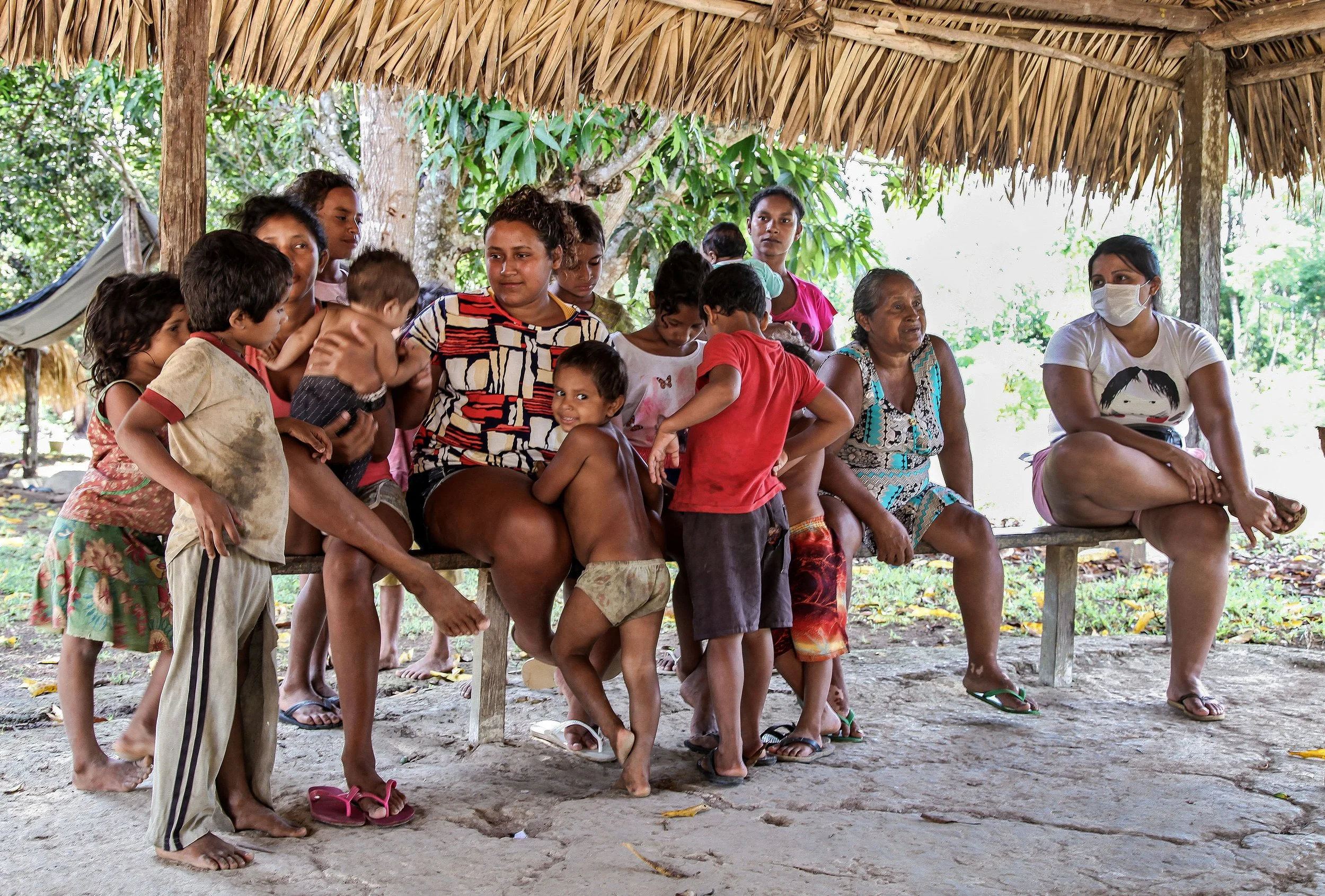
Going forward, the portfolio offers an evidence-based account of what gender outcomes and gender-responsive work look like in the planetary health space. This portfolio brings together the gender dimensions of HIH's work across the geographies where we partner with Indigenous Peoples, Afro-descendants and local communities. Its purpose is to make visible and to evidence how gender shapes and is shaped by the planetary health challenges these communities confront, and how community-designed solutions advance gender equality alongside forest protection and well-being.
“The women leading climate stewardship are doing it with a deficit of recognition and finance, the portfolio says: this is the proof that these solutions work, funders should resource them.”
The Gender Portfolio also advances accountability, holding HIH to its own commitments by naming honestly both what the evidence shows and where evidence is still missing.
“We have a significant body of data showing that when women lead, we see better outcomes, but more broadly, we still need more evidence on causality, which is under-evidenced,” explained Nabil.
“We need more longitudinal data on how women’s leadership leads to health outcomes for forests and people, across generations. We must also assess how gender inequalities impact women’s leadership, as well as how backlash and repatriarchalisation manifest when a woman is made leader. Correcting these areas of understudy is a key step on the path to gender justice.”
With thanks to our speakers:
Brasilia Florensia Netty, Village Leader, West Kalimantan, Indonesia | Christian Eddy Rasambo, BSF Site Lead, HIH–FAMI, Madagascar | Belai Djandam, Advocacy Manager | Farah Nabil, PhD, Grants Portfolio Manager | Sabrina Simon, PhD, Research & Evaluation Associate | Ashley Emerson, Co-CEO for Business and Scale